Selling Homes in Slow Markets: A 7-Step Strategy

Editorial Team 13 min read
Table of Contents
- Step 1: Price Your Home Competitively Using Market Data
- Step 2: Prepare Your Home for Sale with a Checklist
- Step 3: Stage and Style Your Home to Appeal to Buyers
- Step 4: Invest in Professional Photography and Listing Materials
- Step 5: Market Your Property Across Multiple Channels
- Step 6: Understand Timeline Expectations and Repricing Strategy
- Step 7: Negotiate Flexibly and Close the Deal
- Frequently Asked Questions
Last Updated: October 10, 2026
Step 1: Price Your Home Competitively Using Market Data
Pricing is everything when selling homes slow markets, get it wrong and your home sits. Get this wrong and your home sits. Get it right and you attract serious buyers.
Pull comparable property sales from the last 90 days in your neighborhood, homes similar in size, condition, and location that actually sold, not just listed. Then check current active listings to see what's competing for attention.
Pull comparable property sales and current listings
Gather data on at least 5-10 comparable homes, noting sale prices, list prices, square footage, lot size, and condition to establish where your home sits in the market.
Look for patterns: homes in better condition sold faster, updated kitchens commanded higher prices, and homes needing work sat longer. Compare your home honestly to these comparables.
Account for days on market and price reductions
In slow markets, days on market matters. Track how long comparable homes took to sell. If most homes in your area take 45-60 days and you're at day 30, you have room. If comparable homes sell in 20-25 days and yours has been up for 50, your price is likely too high.
If comparable homes listed at $350K sold at $320K, factor that in. Price competitively from day one to avoid the stigma of a price reduction later.
Step 2: Prepare Your Home for Sale with a Checklist
Slow markets reward preparation. Buyers are selective. They'll pass on homes with obvious problems.
Repairs and maintenance priorities
Focus on what buyers notice first: exterior condition, roof, HVAC, plumbing, and electrical. Get a professional home inspection before you list to find issues yourself rather than letting buyers' inspectors discover them.
Prioritize fixes by impact:
- Roof leaks or visible damage
- HVAC system age and function
- Plumbing issues or water damage
- Electrical problems or outdated panels
- Foundation cracks or settling
- Deck or porch safety issues
Minor cosmetic fixes, paint, caulk, weatherstripping, cost little and matter a lot; buyers see neglect in small details.
Cleaning, decluttering, and depersonalizing
Clean the home professionally. Remove family photos, religious items, and personal memorabilia so neutral spaces feel larger and appeal to more buyers. Declutter aggressively, remove 30-40% of what's in each room, open closets, clear kitchen counters, and empty garage shelves so buyers see storage space, not your stuff.
Step 3: Stage and Style Your Home to Appeal to Buyers
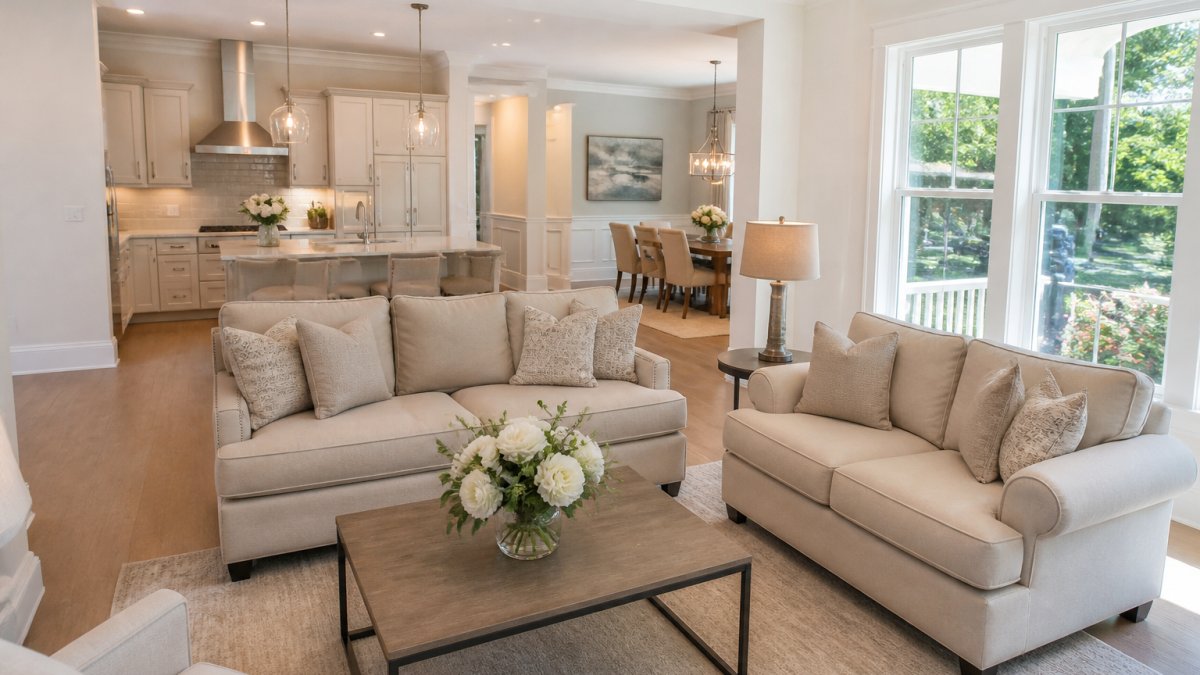
Staging creates emotional connection. Arrange furniture to show flow and function, remove oversized pieces, add fresh flowers and neutral artwork. Open all curtains and blinds, add lamps to dim corners. Help buyers imagine living here by removing distractions and highlighting strengths.
Step 4: Invest in Professional Photography and Listing Materials
Hire a professional photographer to capture space, light, and flow. Include 20-30 photos minimum showing every room, outdoor space, and key feature. Write listing descriptions highlighting what buyers want: natural light, updated systems, storage space, and flow between rooms.
Step 5: Market Your Property Across Multiple Channels
In slow markets, broad exposure is necessary but not sufficient. Measure whether your marketing is reaching buyers and generating qualified interest.
Establish baseline metrics before you list
Before launch, set a performance baseline with your agent: average listing views per week (a $300K home might expect 150-300 views week one, then 50-100 thereafter), average showing requests per week (expect 2-4 if priced competitively), and typical time to first offer. These benchmarks help you spot problems early.
Distribute across owned and paid channels strategically
Owned channels: MLS listing, Zillow, Realtor.com, Redfin, your agent's website and social media. These reach broad audiences but are passive.
Paid channels: Facebook and Instagram ads targeting your zip code and price range, Google Local Services Ads, Zillow or Realtor.com premium placement, and targeted email campaigns. Paid channels cost $200-$1,000+ per month but reach active, motivated buyers and can be worth it if organic traffic is weak.
Diagnose underperformance by channel
After two weeks, review your metrics. If listing views are low, check your MLS description for keywords, verify photos are live on all platforms, and consider paid placement. If views are strong but showing requests are weak, rewrite the description for accuracy or add a virtual tour. If you get showings but no offers, focus on staging, repairs, or repricing.
Allocate budget to high-performing channels
After week two, double down on what works. Track the source of every showing and offer. Over 4-6 weeks, a pattern emerges showing which channels deliver qualified buyers. Invest in high-performing channels and pause underperformers.
Use virtual tours and 3D walkthroughs to filter and qualify
A virtual tour or 3D walkthrough costs $150-$400 and filters out unqualified buyers while converting serious ones. Buyers who take a virtual tour before requesting a showing are 2-3x more likely to make an offer.
Host open houses strategically, not reflexively
Host one open house in week two after initial feedback arrives, so you know what to highlight. Skip open houses if showings are already strong. Use open houses to gather feedback: ask visitors what would make them interested.
Step 6: Understand Timeline Expectations and Repricing Strategy
When selling homes slow markets, repricing is not a failure, it's a diagnostic tool. The key is knowing why to reprice and when, not just cutting blindly.
Build a repricing framework tied to showing feedback
Start by establishing a baseline. In your market, how long do comparable homes typically stay listed before selling? Check your local MLS data for homes sold in the last 90 days. If the median is 45 days, that's your benchmark.
Once listed, track three metrics weekly:
Showing volume and traffic. In the first 7-10 days, you should see 3-5 showings minimum if priced competitively. If you get zero or one showing in the first two weeks, the price is almost certainly too high. Buyers aren't even walking through the door.
Showing feedback and buyer comments. Ask your agent to collect feedback from every showing. Are buyers saying "love the home, price is too high"? That's a pricing problem. Are they saying "needs too much work" or "doesn't feel move-in ready"? That's a presentation or repair problem, not a pricing problem. These are different fixes.
Days on market vs. comparable sales. If comparable homes sold in 35 days and you're at day 28 with no offers, you likely have time. If you're at day 50 with minimal showings, repricing is urgent.
Calculate the financial trade-off: price cut vs. other costs
Before cutting price, compare the math. A 5% price reduction on a $300,000 home costs you $15,000. But what are your carrying costs?
Now add the stigma cost: a home listed 90+ days is flagged as "stale" in many buyer searches. Some buyers actively avoid old listings, assuming something is wrong.
Compare three scenarios:
Scenario A: Cut price 5% now. You lose $15,000 but likely sell in 30-45 days. Total cost: $15,000 + $1,000-$2,000 carrying costs = $16,000-$17,000 out of pocket.
Scenario B: Keep price, wait 60 days, then cut 8%. You lose $24,000 in price reduction plus $4,000-$6,000 in carrying costs = $28,000-$30,000 total.
Scenario C: Keep price, invest $3,000-$5,000 in staging, professional photos, or targeted advertising. If the problem is presentation, not price, this fixes it.
Your agent should help you diagnose which scenario fits your home. If showings are strong but offers are 8-10% below asking, Scenario A (early price cut) wins.
Repricing timeline and decision gates
Set clear decision points from day one:
Days 1-7: Expect initial showing surge. Track volume. If you get fewer than 2 showings, flag for repricing review.
Days 8-14: Assess feedback. If buyers love the home but mention price, or if showing volume has dropped 50% from week one, consider a 3-5% cut. This is early enough to restart momentum without the stale-listing stigma.
Days 15-30: If you have multiple showings but no offers, or if offers are consistently 5%+ below asking, reprice 5-7%. If showings have slowed to 1 per week or fewer, reprice 7-10%. The longer you wait, the bigger the cut needed to restart interest.
Days 31-60: If still unsold, reassess your entire strategy. Is it price, presentation, or market fit?
Step 7: Negotiate Flexibly and Close the Deal
In slow markets, buyers have use. Flexibility wins deals.
Be open to inspection requests, appraisal contingencies, and flexible closing dates. Buyers are nervous in slow markets. Removing their concerns matters more than squeezing an extra $5K.
Consider seller concessions: covering closing costs, offering a home warranty, or including appliances. These cost you less than a price cut but feel valuable to buyers.
Respond quickly to offers. In slow markets, hesitation kills deals. A buyer who feels wanted buys. A buyer who feels ignored shops elsewhere.
Work with your real estate agent to understand what's moving the market. Some buyers want move-in ready. Others want a deal on a fixer. Some need seller financing help. Know your buyer and adjust.
Selling homes in slow markets requires strategy, patience, and flexibility. At Janet Fuller PA, we work with sellers in Volusia and Flagler counties to navigate exactly these challenges. Our team handles the repricing decisions, negotiation strategy, and timeline management so you can focus on your move. The National Association of Realtors' home selling guide outlines these core strategies, and we apply them specifically to your county's market conditions.
Frequently Asked Questions
How do I price my home correctly when the market is slow?
Start by researching comparable properties that sold in your area within the last 90 days. Compare list price to sale price, in slow markets, homes typically sell below asking. Check days on market for similar homes; if comparable homes took 90+ days to sell, price yours 5-10% below market value to attract faster offers. Review current active listings to see where buyers are looking. A real estate agent can pull this data and help you set a realistic asking price that positions your home competitively without leaving money on the table.
What's the timeline for selling a house in a slow market?
In slow markets, homes typically take 60-120 days to sell, compared to 30-45 days in active markets. However, timeline depends on your price, condition, location, and marketing effort. Homes priced aggressively often sell faster; underpriced homes may attract multiple offers within weeks, while overpriced homes can languish for months. Plan for 2-3 months minimum. If your home hasn't received offers after 30 days, be prepared to reprice, improve staging, or adjust your marketing strategy.
Should I offer incentives or seller concessions to attract buyers?
Yes, in slow markets, incentives can move homes faster. Common options include covering closing costs, offering a home warranty, providing a credit for repairs, or including appliances or furniture. Calculate your net proceeds before offering concessions, sometimes a small credit costs less than carrying the home for another 60 days. Flexible closing dates and rent-back terms also appeal to buyers. Discuss trade-offs with your agent to determine which incentives maximize your net proceeds without drastically lowering your sale price.
What home improvements are worth making before listing in a slow market?
Focus on high-ROI repairs: fix major systems (roof, HVAC, plumbing), address safety issues, refresh paint and landscaping, and replace broken fixtures. Avoid expensive renovations unless they're essential, in slow markets, buyers often negotiate repairs into the offer anyway. Prioritize curb appeal and first impressions, which cost less but influence buyer perception immediately. A clean, well-maintained home with minor cosmetic updates typically outperforms a heavily renovated home in a slow market because buyers see fewer red flags and feel confident in the property's condition.